You’ve decided the tree has to go. Maybe it’s dead. Maybe it’s leaning the wrong direction. Maybe it finally dropped a branch that landed three feet from your car, and that was enough.
You call a few contractors. They come out, give you a number, and tell you they’ll clean up when they’re done.
But here’s what almost no one tells you before they start the job: removing a tree doesn’t just affect the tree. It affects everything around it. Your lawn, your driveway, your flower beds, and sometimes your drainage. And the difference between a contractor who planned for that and one who didn’t show up clearly once the truck pulls away.
This post walks through what actually happens to the ground during a tree removal and what it looks like when someone does it right.
The Part Nobody Talks About
Most homeowners think about the tree. They picture it gone, the sky opens up, the stump gets ground down, and life goes on.
What they don’t picture is the 40-foot stretch of lawn that gets tracked up by heavy equipment. Or the ruts left near the driveway edge where a loader had to maneuver. Or the mound of stump grindings spread across the grass that nobody warned them about. Or the muddy scrape marks through the grass where logs got dragged to the chipper.
None of this is a horror story. It’s just reality. Tree removal involves heavy machinery, large logs, and extensive ground contact.
According to established tree risk assessment guidelines, proper planning and execution significantly reduce damage to surrounding property. The question isn’t whether your lawn gets impacted. It usually does to some degree. The question is whether your contractor thought about it before the work started, told you what to expect, and took steps to minimize it.
The ones who didn’t? You’ll know when they leave by looking at the yard.
What Heavy Equipment Actually Does to Your Lawn
Think about the last time you hired someone to do significant work on your property. You probably didn’t call the first name you found. You looked them up. You read what they had to say. You tried to get a sense of whether they were serious — whether they understood your situation, whether they’d communicate clearly, whether you could trust them to do the job right and not disappear afterward.
That’s exactly what our ideal clients do. They’re thoughtful. They’ve been burned by contractors who overpromised. They care about their property — not just as a financial asset, but as a place that carries real meaning for their family.
I wanted someone like that to find our website and feel something shift. Not because we made a bunch of claims. But because they could tell — from the way we explained our services, the way we talked about our approach, the words we actually used — that this company thinks differently.
The new site was built to do that job.
A mid-size tree removal might involve a skid steer, a mini excavator, a chipper, and a large truck. Sometimes all four. Each one has weight. Each one has tires or tracks. And each one leaves a mark.
On dry ground in the middle of summer, the impact is manageable. On soft spring ground, or after two days of rain, the same equipment on the same lawn can create serious ruts. Tracks dig in. Tires spin. Soil compresses under the load in ways that don’t bounce back on their own.
What you’re left with:
Tire ruts and track impressions. These can range from a few inches to several inches deep, depending on ground conditions and how the operator approached the job. A contractor who scouted the property and planned their equipment route in advance can significantly limit this. One who pulled in without thinking it through might not.
Compacted soil. You might not see this one, but your grass will feel it. Heavy equipment compresses the soil structure beneath the surface. Research from university extension programs on soil compaction and lawn health after heavy equipment use shows that compressed soil can significantly reduce water movement and root development. Water and roots have a harder time moving through compacted soil, which often shows up as thin or patchy grass weeks after the job is done.
Surface disruption near the base of the tree. Getting the tree down and sectioned involves work close to the ground. The root flare, the surrounding turf, the nearby flower bed. All of it is in the impact zone. How much gets disturbed depends heavily on the technique, the equipment chosen, and how tightly the crew is working.
A contractor who has done this work long enough knows which approaches cause more ground damage and which ones don’t. They make different choices when they’re thinking about your property as a whole, not just the tree.
Log Placement Matters More Than You Think
After a tree comes down, the trunk gets cut into sections. Those sections have to go somewhere while the crew works.
Where they go matters.
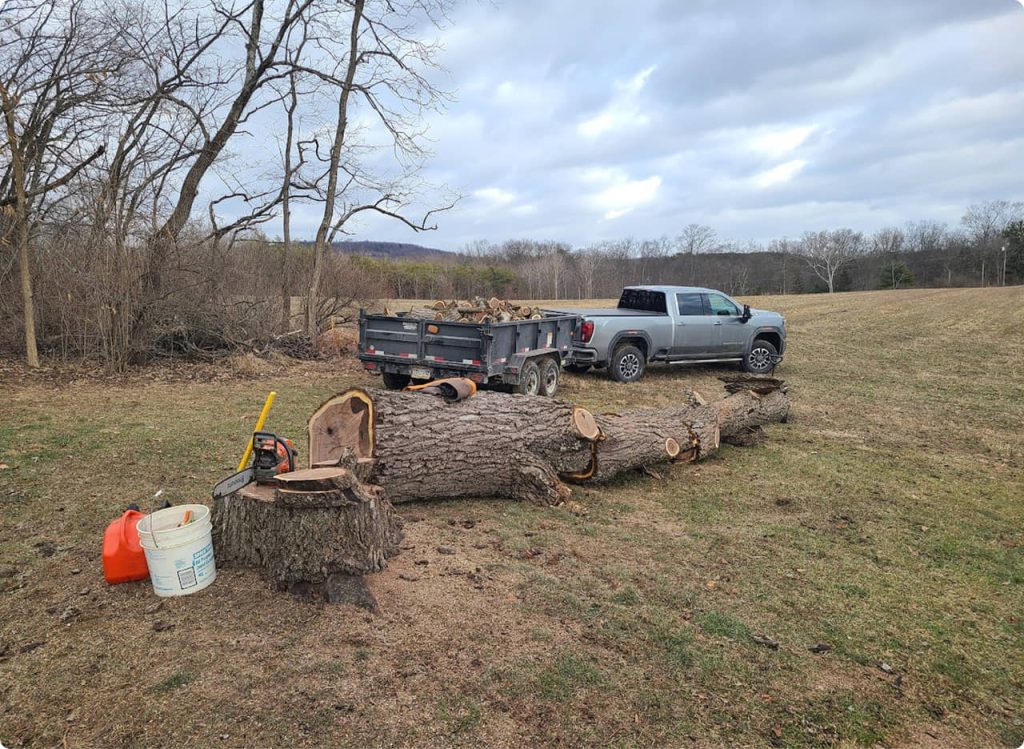
Logs dropped on an open lawn leave impressions. The longer they sit, the deeper the mark. Logs dragged across soft turf tear the surface. Logs stacked near the driveway edge can crack pavers, pop up edging, or compress the gravel base if the weight lands in the wrong spot.
A crew that’s thinking ahead will stage logs on the hardest ground available. Often the driveway surface itself, or a designated spot away from the lawn. They move them efficiently rather than leaving them scattered. They don’t drag them; they carry or load them.
None of this takes extra time. It just takes forethought. When a contractor shows up for a consultation and doesn’t look at the lawn or the driveway approach, they’re probably not thinking about either. When they do look, and they point it out to you, they are.
Stump Grinding Leaves More Material Than Most People Expect
This one surprises almost everyone the first time.
Stump grinding doesn’t make the stump disappear. It converts it. The grinder grinds the stump below grade, leaving a pile of wood chips, sawdust, and soil. Sometimes a significant pile, especially on larger stumps.
That material has to go somewhere. Options include:
- Packed back into the hole. The grindings get pushed into the void left by the stump, tamped down, and covered with topsoil or seed. Over time, it settles, so there’s often a slight depression that needs to be watched and topped off.
- Left on-site for the homeowner to use as much. Some homeowners want it. It can work well around trees or in beds if it’s given time to break down.
- Hauled away. If you don’t want it, it needs to leave with the crew.
What you want to avoid: grindings spread thin across your lawn and left. They don’t break down quickly on turf; they interfere with mowing, and they look like the crew just didn’t know what to do with them.
The right contractor asks you what you want done with the material before the job starts. They factor it into the plan. They don’t leave you standing in your yard afterward looking at a mound of chips, wondering what happened.
What RTL’s Minimal Footprint Promise Actually Looks Like
At Redeemer Tree and Land, we call it the Minimal Footprint Promise. Here’s what that means in the field:
Before work starts, we walk the site. We’re looking at the lawn condition, the soil, the driveway approach, any drainage areas, nearby beds, and the best path for equipment. We’re identifying where we want to set our equipment, where we’ll stage material, and what we’re protecting. You hear all of this during the consultation.
We tell you what ground disturbance to expect in advance. Not a vague “we’ll be careful.” A real conversation: here’s how the equipment will come in, here’s what contact the lawn will take, here’s what we’re doing to minimize it. You don’t find out what happened to your yard by looking at it when we leave. You already knew.
Equipment choices are made based on the job, not convenience. Smaller equipment leaves a smaller mark. We choose the right tool for the conditions, which sometimes means a smaller, slower approach rather than the fastest one.
Logs and material are staged and moved with intent. Not dropped wherever there’s space. Not dragged. Placed on harder surfaces, moved efficiently, and removed clean.
Stump grindings are dealt with by agreement. We ask before we start. If you want the hole filled and seeded, we do that. If you want the material hauled, we will leave it with us. You don’t discover the answer by looking at your yard after we’re gone.
We walk the property with you when the job is finished. Not to rush out. To make sure you see what you paid for and that you’re satisfied before we leave. If something didn’t go as planned, we say so directly, and we address it.
The Stakes of Not Asking These Questions
Here’s the uncomfortable part.
Most people who pick a tree service compare a few quotes and go with the one in the middle. They assume everyone does roughly the same work. They figure cleanup is cleanup.
Then the job is done, and they’re looking at ruts through the middle of the lawn they spent three summers getting right. Or a driveway edge that got clipped by a loader that had no business being that close. Or a mound of stump grindings nobody told them about.
The repairs aren’t always expensive. But they take time. They take effort. And sometimes they take another contractor.
More than that, there’s the frustration of feeling like you weren’t treated with care. Like your property was just a job site, not a place someone lives.
The damage isn’t always visible right away either. Compacted soil shows up in the grass six weeks later. A drainage issue you didn’t know existed gets made worse when disturbed soil settles wrong. A root void under the stump creates a soft spot in the lawn a season later.
Asking a few direct questions before you hire someone costs nothing. Not asking costs more than the repair bill.
Three Questions to Ask Before You Hire a Tree Company
You don’t need to become an expert in tree removal. You just need to know if the person standing in your yard is thinking about the job as a whole or just the tree.
Step 1: Ask how their equipment will enter and exit the property
A contractor who’s thought it through can tell you immediately. They’ll describe the approach, what they’ll drive over, and how they’ll manage the tightest spots. If they shrug, that’s your answer.
Step 2: Ask what will happen to the stump grindings
There’s no right or wrong answer, but there needs to be an answer. They should ask you what you want and confirm it before work starts, not after.
Step 3: Ask what the lawn or driveway will look like when they’re done
Not as a gotcha. As a serious question. What should you expect? How much disturbance is normal for this type of job? A contractor who’s honest about that, even when the answer isn’t perfect, is more trustworthy than one who promises you won’t notice a thing.
If they give you clear, specific answers to all three, you’re probably in good hands. If they’re vague, defensive, or dismissive, pay attention to that.
What It Looks Like When It’s Done Right
When a tree removal is planned well and executed with care, this is what you walk out to when it’s finished:
Your lawn shows the expected footprint of the work and nothing beyond it. The approach path has minimal disruption. Soft areas were avoided or protected. Logs were staged on hard surfaces and removed clean. The stump area is handled as you requested. The driveway is intact.
You’re not standing there trying to figure out how to explain the damage to your spouse. You’re not on the phone with the contractor a week later when you notice the grass dying in a tire track. You’re looking at the space where a problem used to be, and you’re glad it’s gone.
That’s the goal. Not just removing the tree. Leaving the property better than we found it.
Ready to Talk About Your Property?
If you have a tree that needs to come down or a stump that’s been sitting there for two years, reach out to Redeemer Tree and Land for a no-pressure consultation.
We serve homeowners and farm properties across Northumberland, Columbia, Montour, and Luzerne Counties, as well as the surrounding areas of central and northeastern Pennsylvania.
We’ll walk the site with you, tell you exactly what to expect, and give you a clear plan before any work begins.
Call or text us at 570-636-7520 or email Austin directly at Austin.Fiedler@redeemertreeandland.com.
If you’re not ready to call yet, that’s fine too. Save this post. Share it with someone you know who’s been putting off a tree project. When the time comes, you’ll know what questions to ask, and you’ll know who answers them right.